
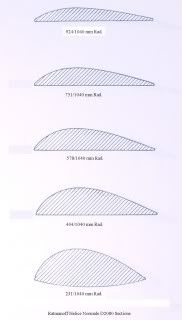
Intrados side (the surface closest to the pilot of tractive props) is flat on Ratmanoff Normale props.
If you want to understand how those props are computed and made, and why they are like they are, you have to read two books from Stefan Drzewiecki, who was the man who computed the Ratmanoff props (Normale Ratmanoff props were "Drzewiecki patented":
- Des Hélices Aériennes, Théorie Générale des Propulseurs Hélicoïdaux (About air Propellers, Global Theory of Helicoid Propellants), published in 1909,
- and Théorie générale de l'Hélice (General Air Screw Theory), published in 1920.
I can't make copies, because they have too many pages, and all had to be read. Pretty fun: the back cover of the first one is a Chauvière advertisement
 You may find the second one in Google Books.
About your sections. IMHO, I think you take it the other way round. Sections are deduced from propeller full size drawings, and used to make templates to control the work in progress. Sections have to show the different laminations, because workers use the shape of the glue lines to make the prop right. Except if you use a numeric cutting machine, but then you will never have a credible replica, because softwares are not designed to make "old fashion" propellers...
About lamination thickness: have you find something? I have looked at some props and found different thiickness, from 16 to 22 mm., but 20 mm. seems to be the most common. I have two Levasseur WW1 props of the same serial, one made by Levasseur and the other by a subcontractor. All measurements are identical, but one have 8 laminations and the other have 9 for a 180 mm. thick hub: look at the pictures...
And I do not understand what you want to do. Prop replica? Airworthy ones? Or to sell them on eBay
 ?
?Regards,
PM
 but "a slight higher pitch" (no number given). This page is correcting data written in the August 1st copy. And those data were 2m08 for diameter and 0m85 for pitch (L'Aérophile 1909 page 352). So, we know the diameter of the "Trans-Channel" flight propeller, and its pitch had to be a little higher than 0m85. But this is far from enough to build a prop! The hub thickness was probably between 90 and 100mm, and the blades width may be guessed from the pictures. But nothing about the shape of the prop: "Intégrale" Chauvière from this period had a concave intrados (how much?) and the pitch was not constant along the blade (higher near the tip): I do not think anybody know how the pitch was varying along the blade.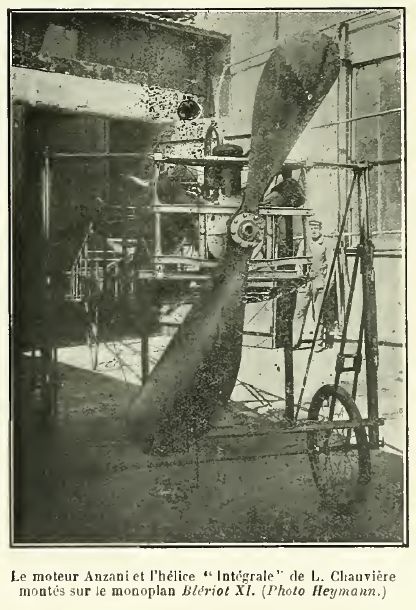
Leave a comment: